Launching july 1
College of Computing
and Artificial Intelligence
The future of learning, discovery, and leadership in the age of AI
UW–Madison names Remzi Arpaci-Dusseau founding dean of College of Computing and Artificial Intelligence
College supported by $100 million in philanthropic support and significant campus investment, including 50 new faculty positions
The University of Wisconsin–Madison has named Remzi Arpaci-Dusseau founding dean of the College of Computing and Artificial Intelligence, marking a major step forward as the university prepares to launch the new college on July 1, 2026.
The launch is also supported by $100 million in philanthropic commitments from the Catalyst Collective — a group of alumni, industry leaders, and corporate partners investing in the college’s early success — alongside more than $50 million in annual institutional investment, some of which will go to support 50 new faculty hires in the college.
The college will include UW–Madison’s existing degree programs in computer sciences, data science, statistics, library science, and information science. It will also create new courses, certificates, majors, and degree programs that reflect the growing importance of AI as a technology reshaping research, education, and work across industries.
A path forward
With a vote by the Universities of Wisconsin Board of Regents in December 2025, UW–Madison was granted the authority to create a new college — the first academic division to be created at UW–Madison in over 40 years.
Launching on July 1, 2026, the college will build on the university’s longstanding strengths in computer sciences, data science, statistics, library science, and information science while advancing UW–Madison’s leadership in artificial intelligence.
The next several months will involve continued engagement with university governance and additional cross-campus consultation process to shape and hone further aspects of its creation.

I’m honored to lead the college at such an important moment; AI is already reshaping society. In moments of major change, universities have a responsibility to engage, not stand on the sidelines. Universities have long helped develop technologies, and that work must continue. But we also have a responsibility to ask hard questions about their impacts, guide innovation thoughtfully, and prepare students to thrive in a changing world.
A university’s role in the AI moment
By helping connect people with deep understanding of artificial intelligence to experts across other disciplines, an imperative of the new college is to accelerate discovery, expand learning opportunities, and foster pragmatic and ethical ways to apply new technology to meet society’s needs.
In the spirit of the Wisconsin Idea, the college will also emphasize translation: moving discoveries from research into practice so they can benefit people, communities, and industries across Wisconsin and beyond. AI should serve as a tool that amplifies human work, helping researchers, students, and professionals expand what they can accomplish.


Catalyst Collective commits $100 million
With the commitment from the Catalyst Collective, the college will be able to move quickly to recruit and support its faculty, expand research capacity, and build programs and infrastructure.
The group includes alumnus Andy Konwinski, alumni John and Tashia Morgridge, alumna Signe Ostby and Scott Cook, and alumnus Jeff Tangney, along with Epic, a leader in healthcare technology. Together, they bring experience across AI, enterprise software, digital health, healthcare technology, and entrepreneurship
Campus investment supports growth
While philanthropic support is helping accelerate the college’s launch, UW–Madison’s annual institutional investment provides the long-term foundation for its continued growth.
Fifty new faculty positions will add to the university’s previous RISE-AI hiring initiative, bringing the new AI-related faculty hires to more than 100. That expanded faculty presence will further strengthen UW–Madison’s leadership in AI and related fields. These faculty will collaborate across campus to advance research and discovery and bolster the university’s expertise to engage with the complexities of AI, including issues of trust, fairness, privacy, and sustainability.

Frequently asked questions
Computing and artificial intelligence are rapidly reshaping research, industry, education, and everyday life. By connecting people with deep expertise in AI to scholars across fields — from philosophy and ethics to medicine, business, and engineering — the college is designed to accelerate discovery, expand learning opportunities, and support practical and ethical applications of new technology.
As these technologies become more powerful and more widespread, society also faces important questions about trust, privacy, fairness, sustainability, and the future of work. A public university has a vital role to play in helping answer those questions through research, education, and innovation that serve the public good.
Naming a new college is never simple, and many faculty, staff, alumni, and students were consulted throughout the process.
A “College of Computing” is a common model at several peer universities, and computing is a broad domain that connects Computer Sciences, the Information School, and Statistics. At the same time, artificial intelligence is emerging from a subdiscipline into a broad force shaping research, education, and society.
After careful consideration, the name “College of Computing and Artificial Intelligence (CAI)” reflects the university’s longstanding strengths and its commitment to leading in our AI-driven future.
The college will prepare students for a changing workforce and create new opportunities through courses, certificates, majors, and degree programs.
It will also strengthen research and discovery across campus by connecting AI expertise with scholars in areas such as healthcare, engineering, business, agriculture, education, and the humanities.
In the spirit of the Wisconsin Idea, the college will help translate new ideas and discoveries into practical solutions that benefit communities, industries, and public institutions across Wisconsin and beyond.
The college will advance innovation while also addressing important questions involving trust, fairness, privacy, sustainability, and the future of work.
Universities have long helped develop transformative technologies. They also play an essential role in studying impacts, asking difficult questions and helping ensure new tools are developed and used responsibly.
UW–Madison’s approach is rooted in both excellence and responsibility: preparing students, supporting discovery, and helping to ensure technology benefits all people.
The launch is supported by $100 million in philanthropic commitments from the Catalyst Collective — a group of alumni, industry leaders, and corporate partners investing in the college’s early success — alongside more than $50 million in annual institutional investment, some of which will go to support 50 new faculty hires in the college. The college will be built with a disciplined, efficient operating model designed to maximize impact and long-term sustainability.
There are many ways to support the college, from philanthropic giving to industry partnerships. Support helps expand student opportunities, advance research, and accelerate the responsible development and application of computing and AI.
To explore giving or partnership opportunities, please contact us at info@cai.wisc.edu or make a gift.
Information for students
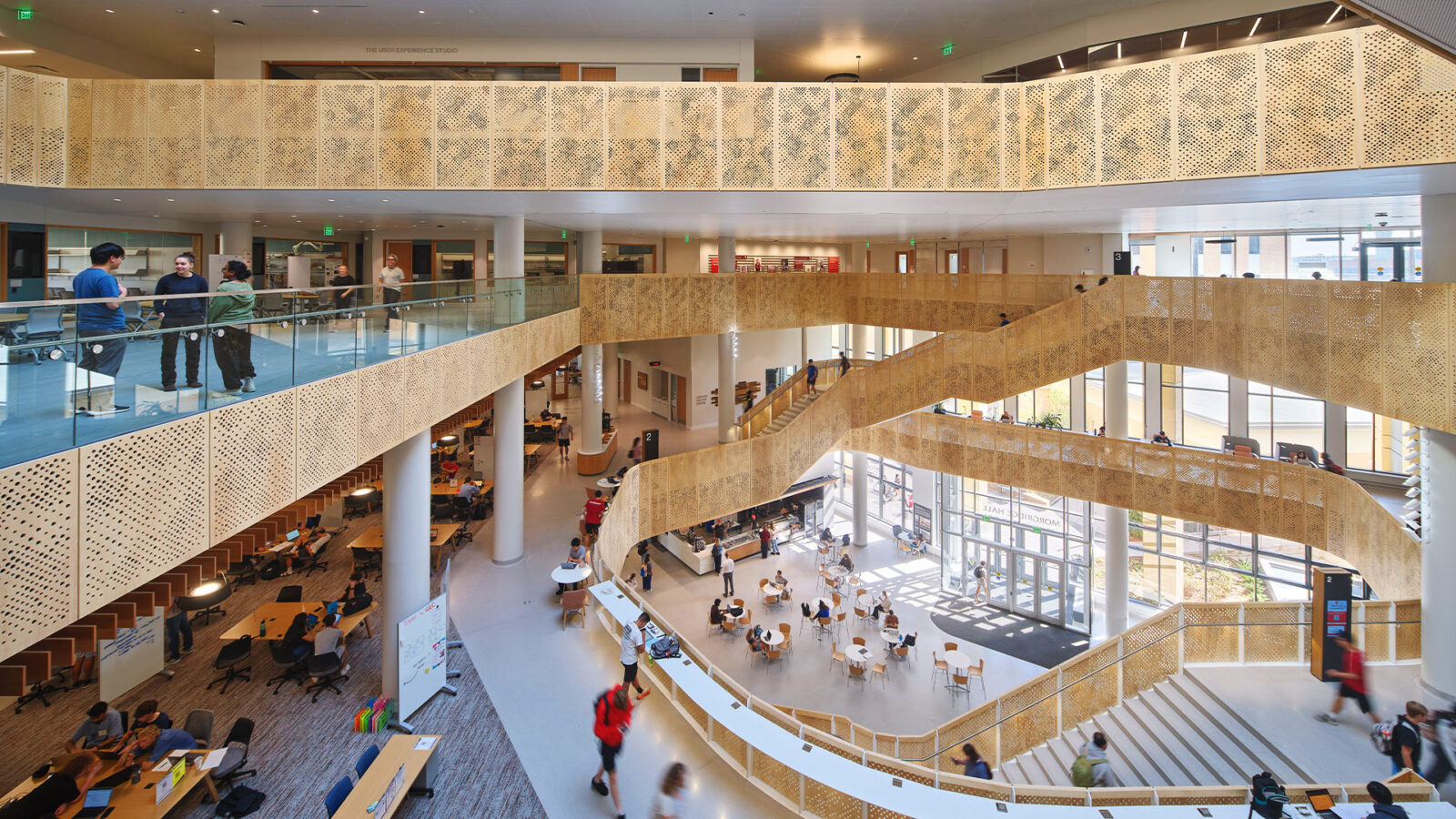
The College of Computing and Artificial Intelligence (CAI) will launch on July 1, 2026, and will include the departments of Computer Sciences, Statistics, and the Information School. The new college’s home will be Morgridge Hall, which opened in fall 2025.
Academic programs (degrees, majors, and certificates) in these departments will not move into the new college until the 2027–28 academic year.
Students will continue to learn from the same outstanding faculty and take the same high-quality courses they know today, with additional opportunities — new courses, programs, and experiences — emerging as CAI takes shape. While some details are still being thoughtfully developed through the appropriate processes, students can expect strong advising, continuity, and even more options to support their academic paths.
If you start at UW–Madison in the 2026–27 academic year with a first choice major interest in computer sciences, data science, information science, and/or statistics, you will enter the College of Letters & Science.
Programs in Computer Sciences, Statistics, and the Information School are anticipated to transition to the College of Computing and Artificial Intelligence starting in the 2027–28 academic year.
All degrees are awarded by the University of Wisconsin–Madison and are confirmed by the school or college that the major is in. Diplomas list University of Wisconsin–Madison alongside the degree name (e.g., Bachelor of Science). Diplomas do not list the school or college that confirms the degree. If you declare one of these majors as an L&S student, your degree will be confirmed by the College of Letters & Science. If you declare one of these majors as a CAI student, your degree will be confirmed by the College of Computing and Artificial Intelligence.
We have not finalized whether degree or major requirements will change when these programs move to the College of Computing and Artificial Intelligence. We’ll share more information as plans are finalized.
You will always have the option to:
- Complete the requirements that were in place when you entered your degree and major, or
- Choose the newer set of requirements*, if available and aligned with your goals.
*We have not finalized if or how requirements will change. More information will be shared as plans are finalized.
No. You won’t need to take any action when the College of Computing and Artificial Intelligence (CAI) is created.
There will be a period when the programs will be offered through both the College of Letters & Science and CAI. You can work with an academic advisor to decide which option best fits your interests and goals.
As degree programs become available (anticipated for 2027–28), we will share details about how new and continuing students can join or transition into these programs.
Learn more
Interested in the current offerings within the School of Computer, Data & Information Sciences?