New startup makes AI ‘show its work’ in healthcare settings
From Assistant Professor Ben Lengerich, Intelligible turns messy data into AI-ready building blocks, with implications for healthcare and beyond.

By Thomas Jilk
The most widely used artificial intelligence (AI) models are powerful but hard to parse. Everyday users cannot know exactly how Google Gemini, for example, arrives at an answer to a prompt. As large language models (LLMs) take on higher-stakes work, their lack of transparency raises a foundational question: Can we build trustworthy systems with opaque underlying technology?
This question becomes especially pressing in environments where lives and livelihoods are on the line. Consider healthcare, an area Assistant Professor Ben Lengerich of the Statistics department studies closely. Lengerich sees the profound potential of AI to improve the healthcare system, but he raised a stark hypothetical to illustrate why it matters that a model can reveal its reasoning.
Suppose a clinician asks AI to suggest ways to save lives at their hospital. “Statistically, the people in the hospital who are at lowest risk of dying are those in active kidney failure,” Lengerich explained. He continued: “If an AI was just looking at raw statistics and not revealing any of its thinking, it might say, ‘Let’s put everybody in kidney failure,’ because they have the lowest mortality rate.” Following that advice would obviously be disastrous.
The example illustrates a classic statistical pitfall of raw correlation hiding the true causal story. Kidney‑failure patients survive because treatment is effective, not because kidney failure is protective. Clinicians cannot afford to have AI models make these kinds of dangerous leaps based on correlation alone.
For this reason, Lengerich said, “We need an architecture that reveals the intermediate steps that these systems are processing through.” In other words, we need AI to show its work. As a leading researcher in interpretable machine learning, Lengerich decided to create that architecture himself.
Years of research on interpretable models convinced Lengerich that the missing piece in modern AI was not always more scale or more data; it was a way to preserve and expose the statistical structure of real‑world datasets. Because the large AI companies were optimizing for scale and not personalized performance on real data, they were not as concerned with making their models’ reasoning more transparent. That realization pushed him from full-time faculty to member to startup founder.
Lengerich’s new company, Intelligible, builds statistical models that learn the structure and meaning of specific datasets, giving AI systems a transparent layer of reasoning that enables more reliable, trustworthy human decision-making. What Lengerich and his team are building now could impact how teams in healthcare and across industries connect data with AI to supercharge problem-solving. Their work is a case study in the kind of translational research the College of Computing & Artificial Intelligence (CAI) advances; ideas that start in a statistics lab can end up transforming how hospitals operate.

When we give AI systems the tools to do statistical reasoning and … show their work … the systems become more accurate, more efficient, and more trustworthy.
Two AI problems converge
The idea for Intelligible emerged from two parallel experiences for Lengerich. The first came from his own research at the intersection of machine learning and precision medicine. Across projects ranging from interpretable neural additive models to personalized regression for genomic and clinical data, his work has consistently focused on building models that surface structure, interactions, and causal signals that clinicians can use. He has also published on practical challenges in biological machine learning, which shaped his push toward systems that preserve and expose intermediate reasoning.
In his work, Lengerich repeatedly noticed that frontier AI models struggled to analyze and interpret data as presented in traditional tables (such as Microsoft Excel files). That is, in part, because with each use, the models start from scratch.
“AI systems look at each dataset anew,” Lengerich explained. “Every prompt you create throws the previous ones away, to some extent. That fresh perspective can be helpful in some scenarios, but data science is typically an iterative process that requires contextualizing each observation within a broader understanding.”
Second, he grew increasingly frustrated with the lack of transparency built into commonly used AI systems. “Most AI architectures are built to scale up, and they’re remarkably good at it,” Lengerich noted. “But that scale optimizes for broad performance,” he said, not for trustworthiness or an understanding of one organization’s data.
Intelligible emerged as an effort to address both the data problem and the transparency problem. “It turns out, when we give AI systems the tools to do statistical reasoning and a storage layer to show their work to the people using them, the systems become more accurate, more efficient, and more trustworthy.”
Lengerich has assembled a team that shares his interest in interpretable machine learning. Rich Caruana, Chief Science Officer at Intelligible and Lengerich’s longtime collaborator, left Microsoft and joined the venture. The CTO, Joshua Shunk, first reached out to Lengerich in 2020 when Shunk was a high‑school student, after writing a paper citing Lengerich’s work. “I was very impressed that he had written this paper and reached out to me,” Lengerich said. Shunk went on to finish his coursework at Stanford in three years, and as Lengerich put it, “He didn’t know what to do with his fourth year, so I told him to come build a startup with me.”
As the team has grown, its roots at UW–Madison have continued to deepen. Antoine Remond-Tiedrez, previously a Van Vleck Visiting Assistant Professor in UW–Madison’s Mathematics department, has joined Intelligible as a member of the technical staff. “It’s rare to find deep technical expertise along with a crystal-clear vision for how that technology can impact critical industries like healthcare — and as soon as tomorrow, not in ten years’ time,” said Remond-Tiedrez.
Together, the group began building Intelligible’s architecture.
How Intelligible works
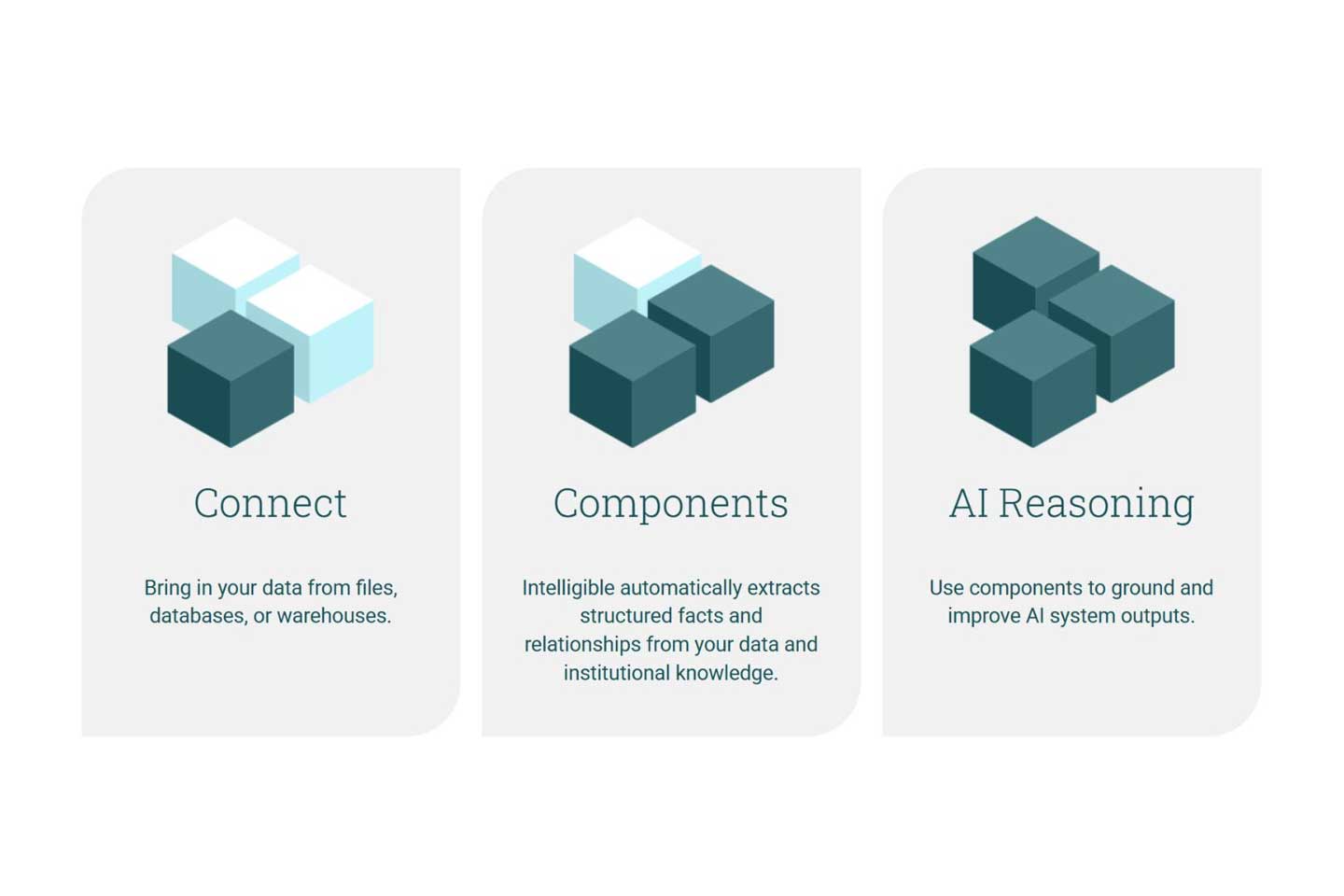
At its core, Intelligible is a statistical project. It captures the structure, interactions and causal signals inside complex datasets to set AI up for success. That statistical grounding makes subsequent reasoning more trustworthy. The company’s core innovation is deceptively simple: to break down messy, large-scale datasets into small, interpretable chunks that both humans and AI systems can understand.
“The idea is that we can break complicated data into small components that humans can reason about,” Lengerich said. These components make data interpretable, explainable, and ready for AI. They then form a statistical foundation that AI systems can draw on moving forward. Instead of starting from scratch, they can reason with context.
“Statistical models create a very good representation of what a dataset means,” Lengerich said. “They allow you to build a chain of component‑based reasoning, not just one black-box system.” That chain of reasoning underlies the company’s customer-facing platform, Summand, which enables users to “chat” with their data and enterprises to build trustworthy AI systems.
This context-adaptive system could unlock useful new insights for organizations; in fact, it already has. For one logistics company, the Intelligible team uncovered roughly $20 million in missed pricing opportunities after running a retrospective analysis, Lengerich said.
In healthcare, interpretable AI could help surface opportunities to improve care, reduce waste, and benchmark performance more accurately. Rural health networks, Lengerich explained, stand to benefit significantly. “Many hospitals can only afford to pay $1000 a month for an AI tool,” he said, and Intelligible could help under‑resourced hospitals harness AI to identify gaps and improve outcomes without relying on costly consultants. The opportunity isn’t lost on healthcare leaders.
“One of the most interesting aspects of artificial intelligence in healthcare is its potential to help people draw new insights from increasingly complex and vast amounts of information,” said Elizabeth Hagerman, PhD, Chief Innovation Officer at UW Health. “For health systems, technologies that can identify insights across hospitals, clinics, and operational functions could support more informed decisions and ultimately improve the way we serve patients,” she added. “We’re encouraged by efforts to advance these technologies and look forward to continuing to learn about how emerging approaches may contribute to improving healthcare.”
Lengerich added that some people see interpretability as a constraint on what AI can do. In theory, if a system has to show its work, it could lead to a slower workflow than using black-box LLMs. But Lengerich takes an optimistic view. “Maybe interpretability is a constraint, but it’s a beneficial constraint that often leads to better system design.”
Lengerich’s path, from foundational work in interpretable machine learning to a company putting those ideas to work in healthcare and industry, illustrates the kind of translational work CAI exists to accelerate: advances computing, data and statistics that move beyond the lab and into settings where they can improve people’s lives.
Ben Lengerich runs the Adaptive Inference Lab at UW–Madison, which is now accepting student applications. Visit the lab website for more information.
Related:

From the lab to the NICU: Pioneering contactless health monitoring
A team of UW–Madison computer scientists designed a new, contactless health monitoring system, paving the way for safer, more comfortable patient care.