The future she helped make possible: Remembering Tashia Morgridge
An educator, philanthropist, and champion of opportunity, Tashia Morgridge helped create a place where generations of students will learn, discover, and grow.
By Shannon Timm
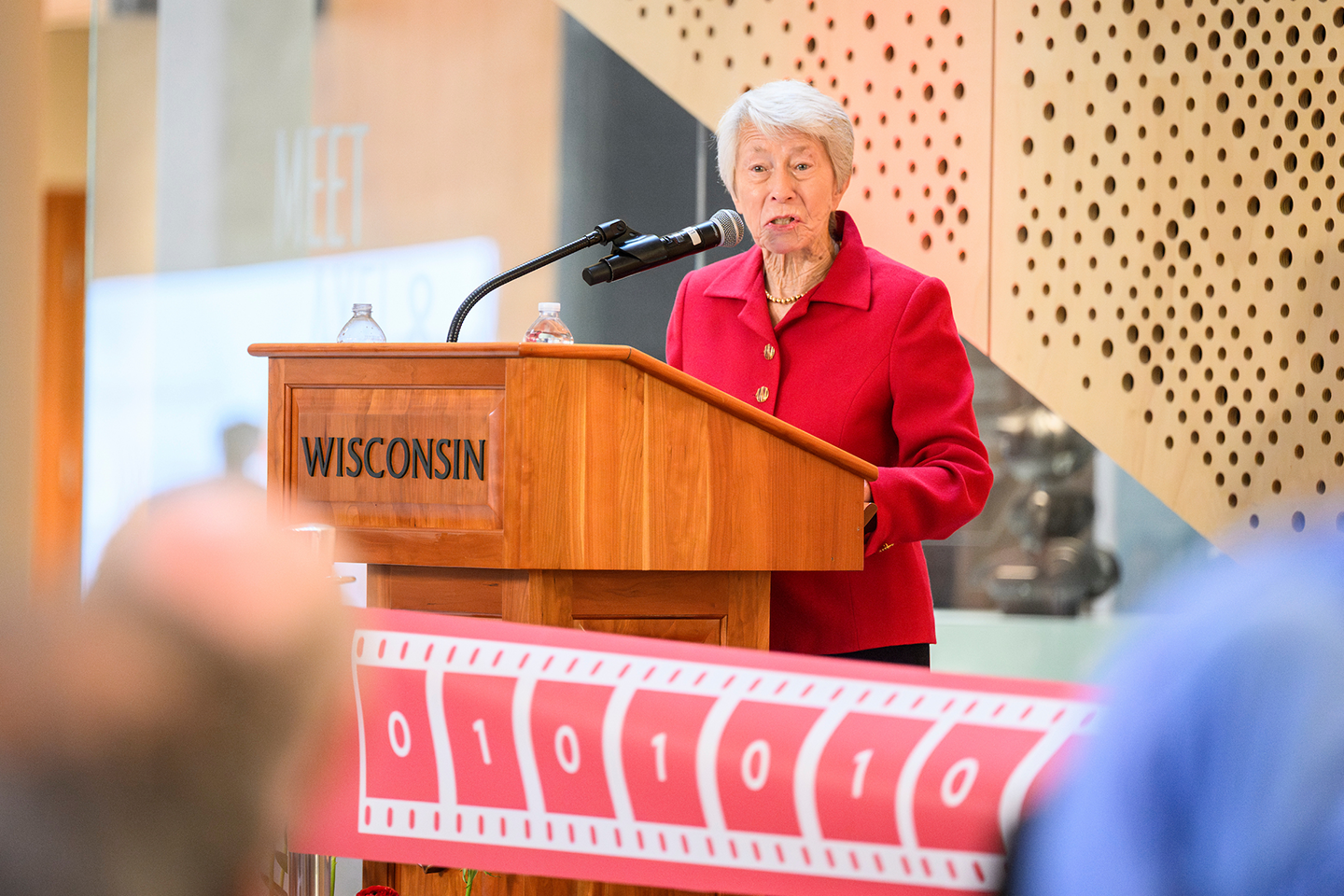
When Tashia Morgridge stood in the soaring heart of the University of Wisconsin–Madison’s new Morgridge Hall in September 2025, she asked the audience to look up.
Behind her rose a staircase connecting the building’s seven floors. To Tashia, it represented something much greater than a way to move through a building.
She spoke about the effort it takes to climb, the discoveries made along the way, the people we meet, and the ways we grow through new experiences.
“When you look down on the steps you climbed, you’ll have a feeling of accomplishment, of fulfillment, of knowing you reached a goal,” she told the audience gathered for the building’s ribbon cutting. “By the time you get all the way up there, just think of who you’ll be.”
It was a fitting message from a woman who spent much of her life helping others discover what they could become.

When you look down on the steps you climbed, you’ll have a feeling of accomplishment, of fulfillment, of knowing you reached a goal. By the time you get all the way up there, just think who you’ll be.
Tashia Morgridge ’55, who passed away on October 30, 2026, leaves a remarkable legacy at UW–Madison. Together with her husband, John Morgridge ’55, she helped create opportunities for generations of people they would never meet.
Those opportunities have a particularly meaningful home in Morgridge Hall.
The 343,000-square-foot building, made possible through the extraordinary generosity of the Morgridges and other donors, brings together students, faculty, and researchers across computing, data, and information sciences. John and Tashia’s $140 million commitment, including a $50 million challenge grant that inspired additional philanthropic support, helped make the building a reality.
Guri Sohi, the E. David Cronon professor of computer sciences and Vilas Research professor at UW–Madison, remembers Tashia talking about the importance of creating “collisions” — bringing people and ideas together in ways that spark new connections and discoveries. That same philosophy is reflected in Morgridge Hall, which was intentionally designed to encourage intellectual collisions across disciplines.
And already, the building is becoming the kind of place Tashia envisioned.
In a spring 2026 survey, students described Morgridge Hall as inviting, comfortable, and full of opportunities to connect with others. They praised its collaborative spaces, quiet corners for studying, and the sense of community they have found there.
One student shared that their favorite part of the building was “taking my friends from other schools there and showing them how cool the building is.” Another described spending entire days there, moving between work, classes, and studying.
For Tashia, an educator who believed deeply in the transformative power of learning, the building represented an investment in human potential.
Its greatest accomplishments would not be measured in square feet or architectural features, but in the lives of the people who would fill it.
Investing in a future of possibility
John and Tashia’s commitment to UW–Madison extended far beyond the walls of Morgridge Hall.
Their philanthropy helped establish the foundation for the university’s College of Computing & Artificial Intelligence (CAI), launched in July 2026. As members of the Catalyst Collective, they joined other alumni and partners in committing a combined $100 million to help launch the new college.
Together, these investments provided a home for the college and a foundation for expanding education, research, and collaboration across computing and artificial intelligence.
For Tashia, the promise of these investments was not simply what the university could accomplish, but what students, educators, and researchers would be empowered to do in the years ahead.
“What made Tashia so special was her genuine curiosity about people and the world around her,” said Remzi Arpaci-Dusseau, founding dean of CAI. “She believed deeply in the power of education, but she also wanted to understand the challenges and possibilities ahead. She asked thoughtful questions, cared about the impact of our work, and never lost sight of the people at the center of it. That’s a legacy that will continue to shape this college for generations.”
The person behind the philanthropy
For Tashia, education was both a profession and a lifelong commitment.
After graduating from UW–Madison in 1955, she dedicated her career to teaching, including work in special education and literacy intervention. Her experiences as an educator informed a philanthropic philosophy centered on expanding opportunity for others.
That commitment was evident in the personal interest she took in the people and projects she supported.
Miron Livny, the John P. Morgridge professor of computer sciences and chief technology officer of the Morgridge Institute for Research, remembers that Tashia had a particular way of approaching conversations.
Rather than asking only about plans and accomplishments, she wanted to know what worried people most. It was a question that invited honesty and reflected her genuine interest in understanding the challenges behind ambitious ideas.
Livny also remembers sharing photographs with Tashia of the Discovery Building, home to the Morgridge Institute for Research, filled with children, students, and visitors. She enjoyed seeing the building come to life, and some of those photographs even found their way into the scrapbooks she assembled each year.
For Tashia, the impact of an investment was ultimately measured in people. That same curiosity extended to the future of artificial intelligence.
In a conversation with CAI Founding Dean Remzi Arpaci-Dusseau, Tashia asked thoughtful questions about artificial intelligence and its implications for society. Their discussion reflected a shared belief that technological progress must be accompanied by careful consideration of its impact on people.
For Arpaci-Dusseau, the exchange was a memorable example of Tashia’s curiosity, thoughtfulness, and genuine interest in the future of the college. Her perspective reinforced a commitment central to CAI’s mission: advancing computing and artificial intelligence in ways that benefit people and society.
A lifetime of helping others climb
Larry Landweber, a UW–Madison professor emeritus of computer science and longtime friend of the Morgridges, remembers the many bicycle trips he and his wife, Jean, shared with John and Tashia during the 1990s.
He recalls Tashia’s “unbounded energy,” playful sense of humor, and the genuine care she showed for family and friends. Despite the extraordinary impact she and John would have on the university, she remained remarkably down to earth.
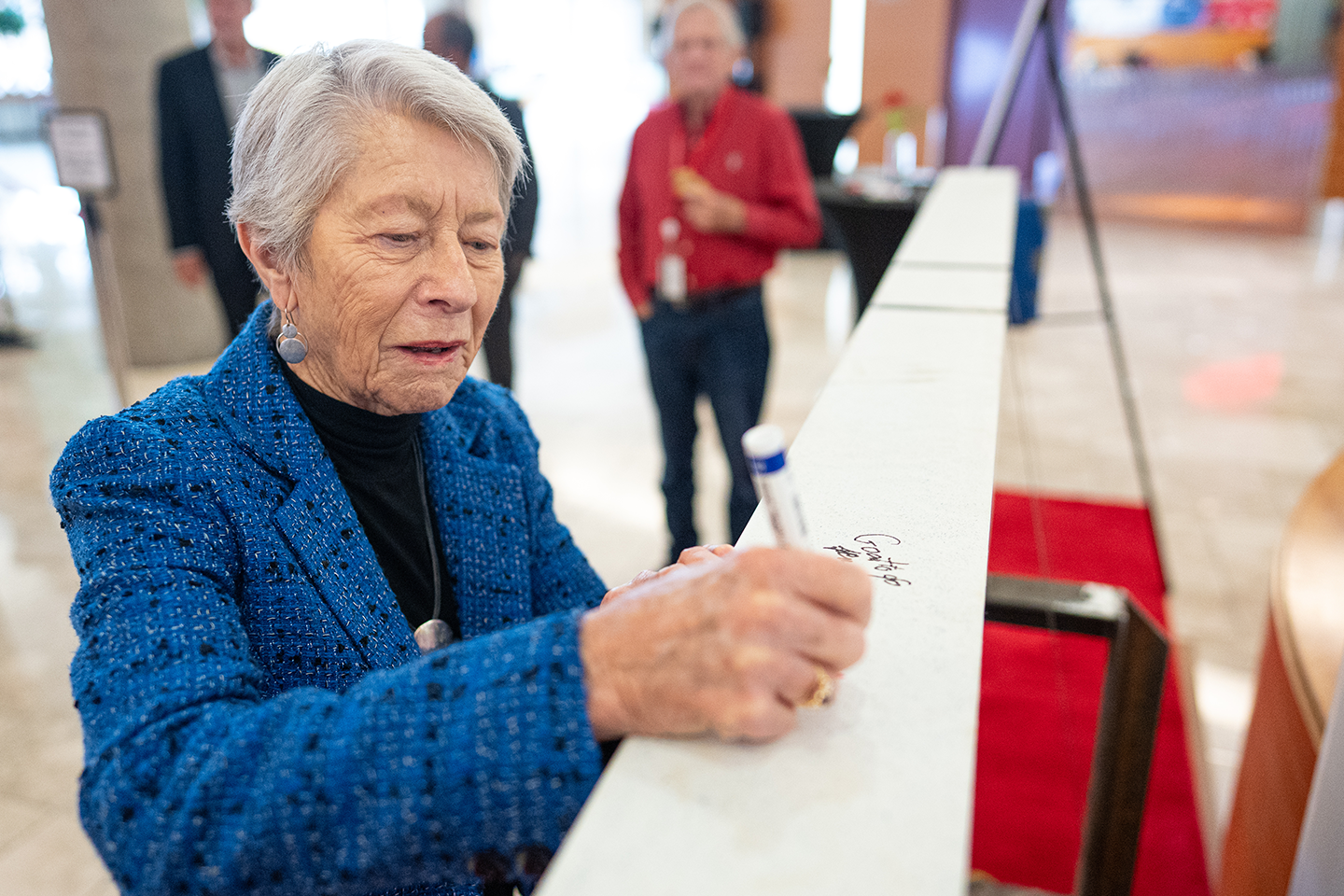
At the Morgridge Hall ribbon cutting, Tashia reflected on the many climbs she and John had undertaken throughout their lives, from mountain trails and outdoor adventures to the challenges and joys of raising a family, building careers, and giving back.
“At our age, we’ve done a lot of our climbing,” she said with characteristic humor.
She spoke with gratitude about the people who had enriched their journey and the experiences that had shaped their lives.
Then she turned the audience’s attention back to the building and the people who would make it their own.
For generations of students, Morgridge Hall will be a place to take on challenges, discover new perspectives, form lasting relationships, and grow into people they cannot yet imagine becoming.
Tashia would not know most of their names. She would not witness every discovery or see where their journeys would lead.
But she believed in their potential all the same.
Recent:

Ever-Green Morgridge Hall
The new home of the College of Computing & Artificial Intelligence is the most sustainable building on the UW–Madison campus.