Time to dig
To celebrate UW–Madison’s new College of Computing & Artificial Intelligence, Founding Dean Remzi Arpaci-Dusseau digs deep into the technological moment around us.
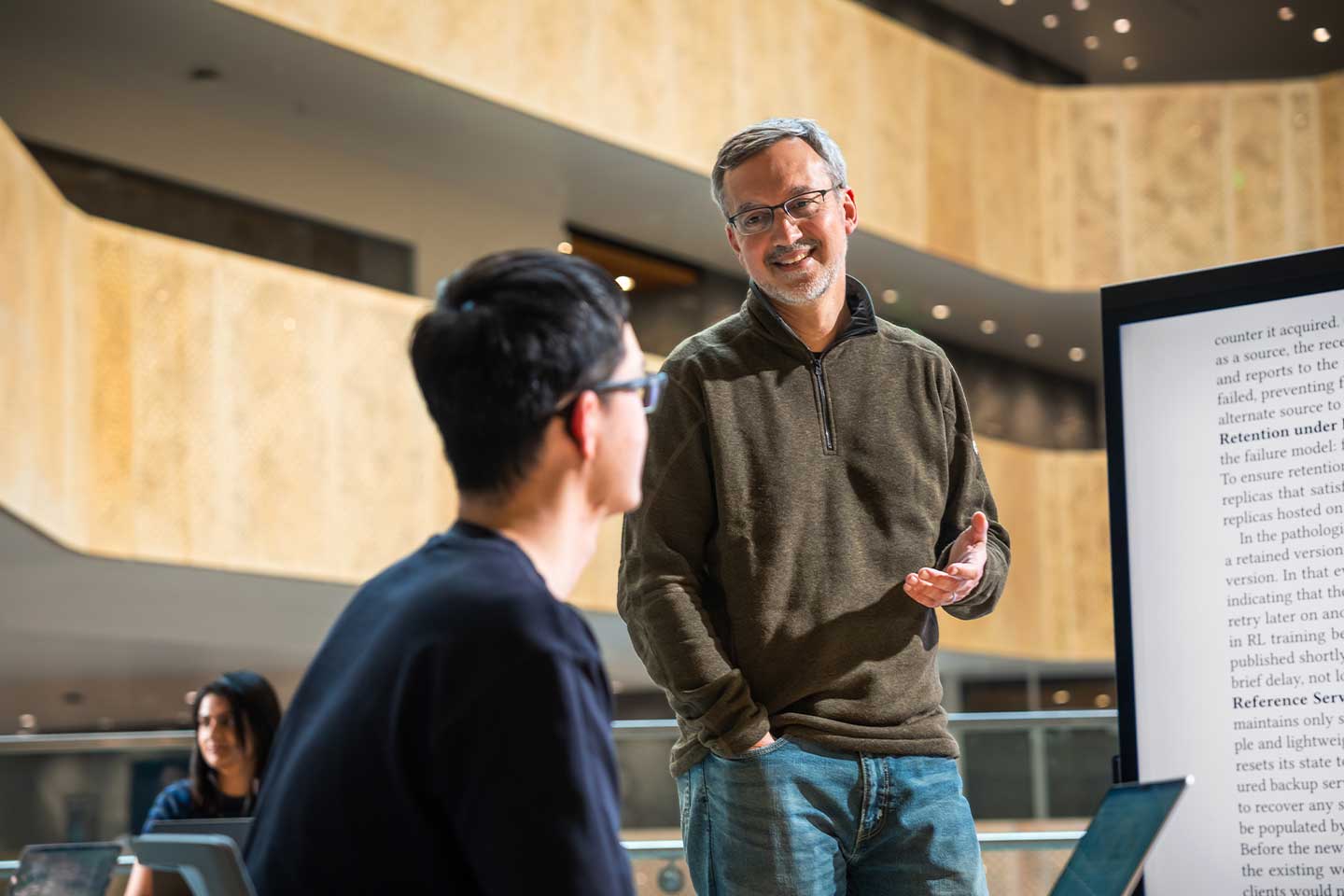
By Founding Dean Remzi Arpaci-Dusseau
These miraculous machines!
Do we shape them
Or do they shape us?
Or reshape us from our decent, far designs?”
The lines above, from Russell Lord’s piece “The Ground from Under Your Feet,” are about machines that were changing the face of agriculture. They remain prescient today. As new technologies rapidly reshape how we live, work, learn, and discover, the question is no longer simply what these tools can do. It is whether we will shape their future — or allow them to shape ours.
A new college, built on strong foundations
At UW–Madison, our broadest answer to this central question is the creation of a new college, the College of Computing & Artificial Intelligence (CAI). CAI breaks new ground at UW as the first new college created at this proud land-grant university in more than 40 years.
CAI is a new college, but it is built on a long history. I’ve spent 26 years as a professor of Computer Sciences at UW–Madison, as a researcher, teacher, and mentor. The departments that now form CAI — Computer Sciences, the Information School, and Statistics — have spent decades educating students, advancing discovery, and serving our state. Together that history gives me confidence in how we will meet the moment and a profound sense of responsibility as I begin serving as the college’s founding dean.
The technological moment
The college arose in response to these new and significant technological forces, ones that are changing not only how we think about research and education, but also the future of work, innovation, and many facets of modern society. Some of these shifts are unsettling, creating uncertainty about the future, and contributing to distrust in technology and the industries driving it. Yet they also hold tremendous promise, as new tools to accelerate research and discovery, enhance learning and education, and help us find solutions to the most vexing problems facing the world today.
With such a consequential moment before us, it is critical that UW–Madison — and universities more broadly — play a central role in stewarding these changes. CAI will not simply be a college about tools and technologies, but rather one that helps define how powerful technologies and human judgment work together toward a greater, public good. Certainly, we will develop new technologies, as any top research university should. Just as importantly, we will educate people who can build, explain, question, and apply these technologies wisely.
Years in the making
Today’s launch, however, is not the beginning of our work. Like any worthwhile endeavor, we’ve been preparing for this moment for years. In 2019, UW–Madison brought together three outstanding departments — Computer Sciences, the Information School, and Statistics — into the School of Computer, Data & Information Sciences, creating stronger connections across disciplines and laying the groundwork for today’s launch of CAI. These departments, with over 100 faculty and roughly 5,000 students, serve as the roots of the new college.
A field comes of age
Of course, we’ll continue expanding our educational programs, advancing research, building partnerships, and investing in outstanding faculty. Those are important responsibilities, and they will help shape the college in the years ahead.
They are the work we will do. They are not, however, the larger purpose we hope to serve.
The purpose begins with recognizing that intellectual fields, much like people, mature over time. Many of the domains within CAI, as fields go, are still young. They have grown up fast, and often in one direction: toward capability, toward what could be built and how quickly. That restlessness has (mostly) served the world well. But maturity asks different questions: not only what we can build, but what is worth building; not only how a system works, but for whom it works. A field comes of age the way a person does, when its power is finally matched by its judgment.
Other disciplines have experienced similar moments: Chemistry transformed the world; so too did Physics. As those fields matured, they were called on not only to advance their science, but also to grapple with its consequences, responsibilities, and place in society. Computing is entering its own moment of maturation.
This process of development and growth is where universities have a unique role to play. At a time when trust in technology has been tested, universities can serve as trusted voices — places where difficult questions are welcomed, where ideas are challenged, and where students learn not only how to build technology, but how to exercise good judgment in applying it.
This maturation is central to our hopes for CAI. We are fortunate to have faculty who combine deep technical expertise with the courage to engage the broader questions their work raises. Through their research, teaching, and mentorship, they will educate the next generation to do the same. As these technologies become more powerful, so too does the responsibility of those who understand them most deeply. Our ambition is to ensure that they remain guided by thoughtful human judgment — not simply by what is technically possible.
Coda
In 1942, Robert Flaherty’s documentary The Land, narrated by Russell Lord, detailed the powerful impact that machinery was having on farming and agriculture. At first, many of the effects were troubling (such as mass soil erosion); however, as noted in the documentary, mastery of machines could lead to a world of “freedom and abundance.” Key to achieving these goals were people: “their skills, their inventiveness, their resourcefulness, their education.”
The specific tools may be different, but the question remains the same. Within CAI, we too believe that people – with their skills, inventiveness, resourcefulness, and education – will be the drivers of these technologies. Instead of technology that feels like it is being done to us, CAI will work towards a future where the power of the tools is clearly for us: for each individual human, for the broader public good.
The dirt may be fertile, or it may be tough; the temperatures pleasant or hot; indeed, not much is certain in this shifting landscape before us. But, as with any meaningful endeavor, there is only one thing we can do next: start digging, and plant the seeds for our human-driven future.
Learn more about the College of Computing & Artificial Intelligence.
Related:
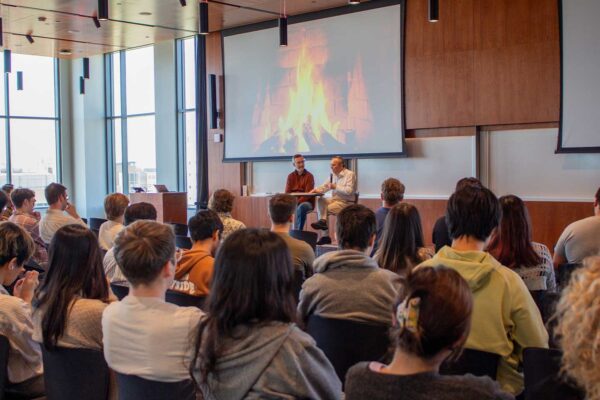
ACM president: New college will make UW–Madison “even more amazing”
Responsible AI will require close collaboration with “the entire spectrum of humanities and social scientists,” says ACM president. That’s where the UW’s newest college comes in.