ACM president: New college will make UW–Madison “even more amazing”
Responsible AI will require close collaboration with “the entire spectrum of humanities and social scientists,” says ACM president. That’s where the UW’s new College of Computing & Artificial Intelligence comes in.
Words and photos by Rachel Robey
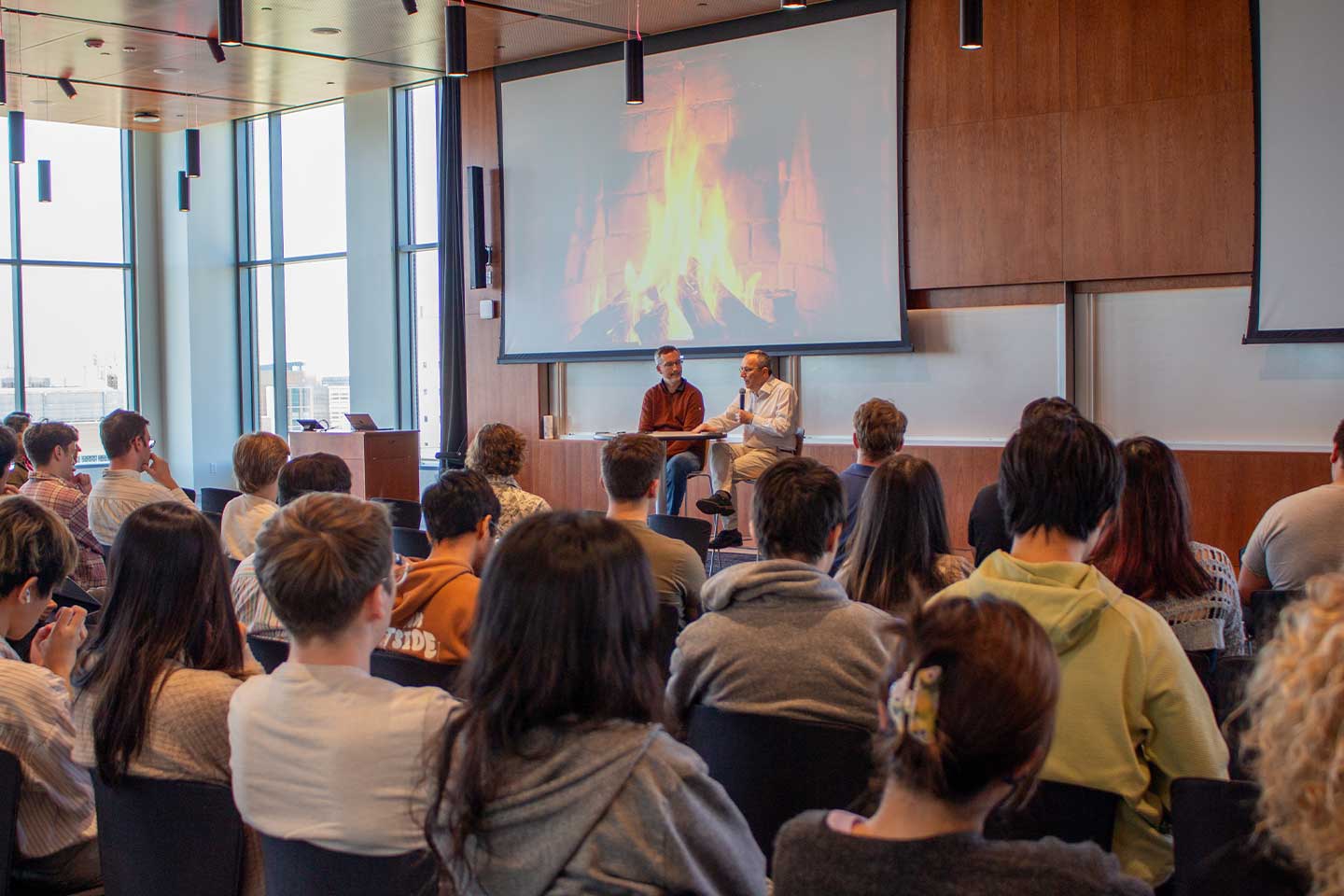
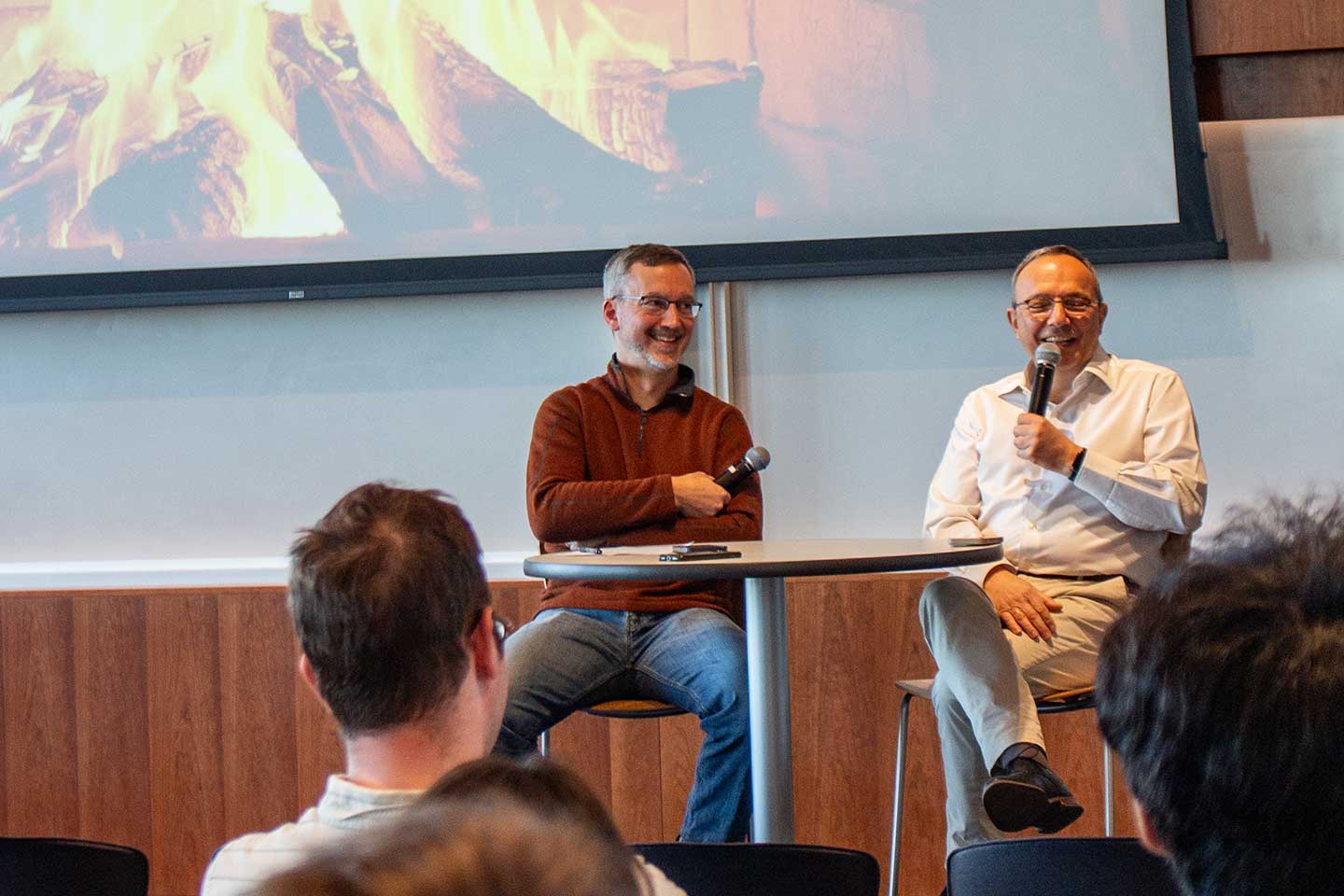
Faculty, staff, and students recently gathered for a fireside chat featuring Yannis Ioannidis, president of the Association for Computing Machinery (ACM), and professor Remzi Arpaci-Dusseau, the founding dean of UW–Madison’s College of Computing & Artificial Intelligence (CAI). Hosted in Morgridge Hall, the conversation looked ahead to the future of artificial intelligence (AI) as well as back to Ioannidis’ time as a professor at UW–Madison.
“Even though Yannis had already left for the National Technical University of Athens by the time I arrived at UW–Madison, his influence in the databases group was long lasting,” reflected Arpaci-Dusseau, who arrived in Madison as an assistant professor in 2000. “Everyone knew about Yannis, not only for his prowess as a researcher, but his incredible dedication to the classroom and teaching.”
Throughout the event, Ioannidis fielded questions from faculty and students, weighing in on AI’s far-reaching impact from academic publishing to college classrooms and beyond. With respect to the computer science field writ large, he likened it more to a sea change.

Having [the College of Computing & Artificial Intelligence] with a dean that will interact with the entire campus will make [UW–Madison] an even more amazing place than it already is.
“Through AI, we will have a much bigger influence on other sciences than we’re used to,” said Ioannidis, stressing the weight of this responsibility. “Pretty much the entire spectrum of humanities and social scientists have to be in the room with us discussing how to apply AI.” For UW’s computer scientists, that could mean expanded collaboration across the natural sciences, life sciences, and humanities. Not only to accelerate research in those domains, but as a critical element in the development of responsible and ethical AI.
As Dean Arpaci-Dusseau noted in an interview with Wisconsin Today, “We’re not here to be AI cheerleaders. A university is here to be an educated, thoughtful leader in these very challenging spaces.” The study of AI and the development of safe applications will require collaboration with critics and proponents alike, he said.
So, how do we invite that collaboration?
The College of Computing & Artificial Intelligence
AI isn’t going anywhere, said Ioannidis. Instead, it’s going everywhere: into biology, astronomy, soil science, the classics, ecology, economics, and beyond. If it ends in “ology,” AI is impacting it, sending shockwaves through every facet of society and field of research.
Simultaneously, computing is increasingly central across all fields. Researchers overwhelmed with too much data — that is to say, most researchers alive — lean on computing for processing, managing, and analyzing information. Ioannidis praised UW–Madison’s decision to invest in these areas through the new college, arguing it will raise all boats: “Having [the College of Computing & Artificial Intelligence] with a dean that will interact with the entire campus will make [UW–Madison] an even more amazing place than it already is,” he said.
A counterweight to industry
According to Arpaci-Dusseau and Ioannidis, another critical role of the College of Computing & Artificial Intelligence will be to offer a cautious counterweight to the speed of industry and market trends. Tech companies are beholden to investors, boards, and bottom lines, they said, with little bandwidth (or motivation) to investigate the ethical quandaries of AI.
“Industry really doesn’t want regulation or restrictions; it wants to reach the financial goal as fast as possible,” explained Ioannidis. “We need to find the right balance that enables innovation and wealth creation without compromising on ethical standards.”
In contrast, universities are well positioned to study AI from a holistic perspective. Not only is there a wealth of researchers whose work would benefit from the amplifying power of AI, but there are also plenty of divergent voices who remain skeptical. (Case in point: The new Center for Humanistic Inquiry into AI and Uncertainty, which will explore the rise of AI from every humanistic angle, features several CAI faculty members on its advisory board.)
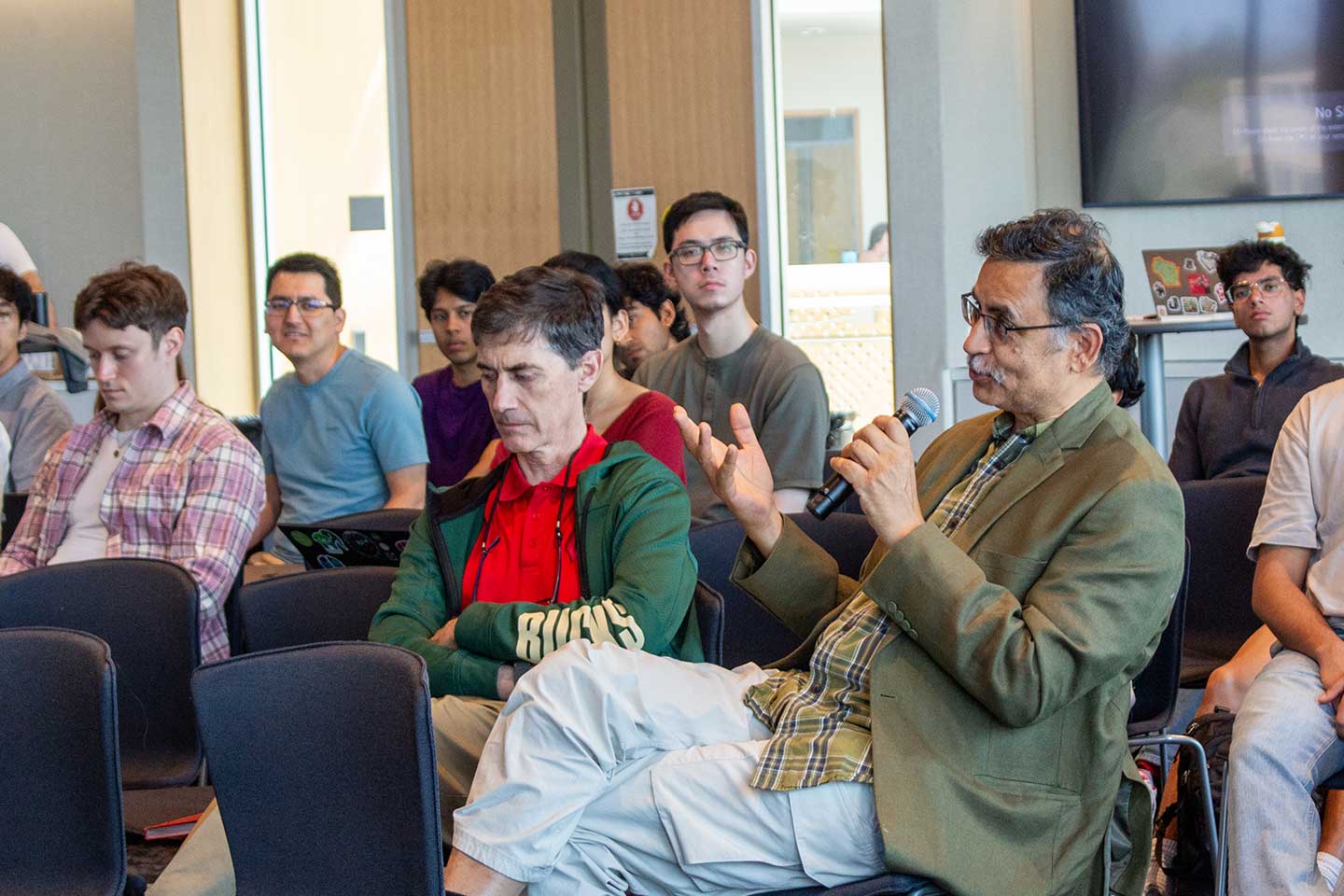
“We need regulation on the use of AI, and for that you need people who understand laws and regulations, how to write them, and so on,” said Ioannidis. “You need philosophers, and especially ethicists. You need behavioral psychologists.” Few places can accommodate those requirements quite like a university.
Studying AI in a university environment will also contribute to safer, more ethical AI use, Ioannidis and Arpaci-Dusseau both say. And importantly, it will also teach students to think critically about how and when tools like AI can and should be used — another valuable check on the proliferation of AI.
“It’s our responsibility to innovate, pioneer, and explore,” concluded Ioannidis. UW–Madison’s newest college will do just that.
Learn more about the College of Computing & Artificial Intelligence (CAI).
Related:

Six lessons for preparing AI-savvy students and citizens
In LIS 408, a non-technical course on generative AI, Professor David McHugh teaches students to strategically apply, evaluate, and critique artificial intelligence systems.